
Did you see it?

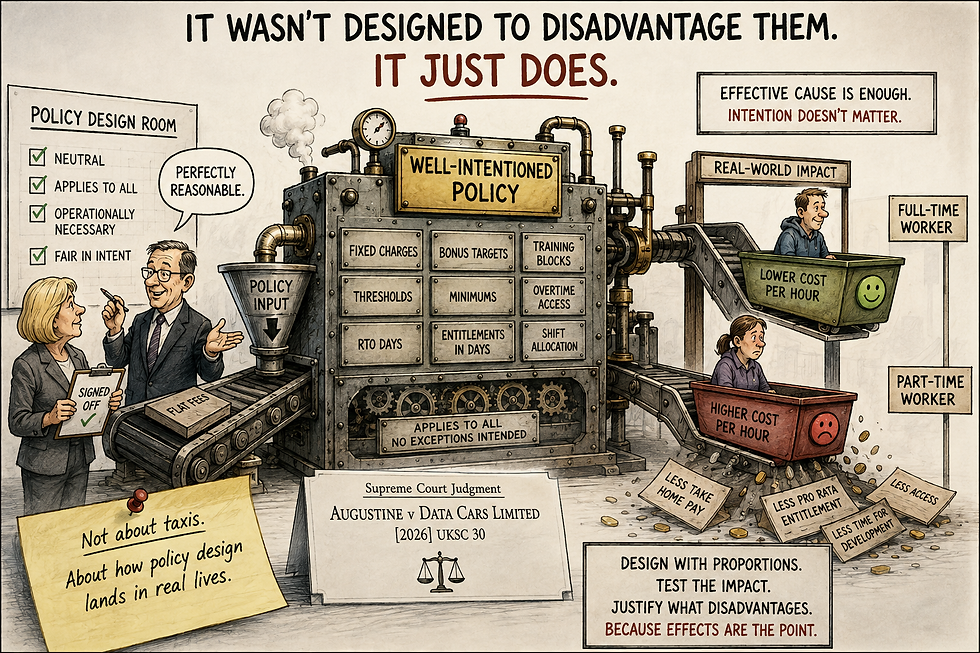
Probably not. It landed on 12 August, in the dead centre of the summer lull, in a dispute about a private hire driver and a weekly access charge, and it was covered, where it was covered at all, in the trade press rather than anywhere a chief executive might trip over it. There was no ministerial statement, no press conference on the steps of Parliament Square, no particular fanfare. And yet Augustine v Data Cars Limited [2026] UKSC 30 may prove to be one of the more consequential developments for the people profession this decade, and the reason has almost nothing to do with taxis.
The facts are close to aggressively mundane, which is rather the point. Warren Augustine drove for a small private hire firm. Like every other driver on the books he paid a fixed weekly "circuit fee" of £148 for access to the company's booking and dispatch system, a charge levied identically on everyone regardless of the hours they actually worked (Faragher, 2026). Because Mr Augustine drove fewer hours than his chosen comparator, arithmetic did the rest. He paid materially more per hour worked for the privilege of working, and took home a smaller proportion of his earnings than a colleague doing the identical job for longer (Augustine v Data Cars Ltd, 2026, para. 33). He first brought his claim in 2016. Ten years, four courts and a great deal of pro bono legal effort later, the Supreme Court agreed with him.
The narrow question, and why it is not narrow at all
The point of law was almost fussily technical. Regulation 5 of the Part-time Workers (Prevention of Less Favourable Treatment) Regulations 2000 protects part-time workers from less favourable treatment where the treatment is "on the ground that" they are part-time and is not objectively justified. The European framework agreement behind the Regulations uses the word "solely". The domestic Regulations do not. For nineteen years the appellate courts of the United Kingdom had been split on whether that omission mattered, with the Inner House in McMenemy v Capita Business Services Ltd (2007) holding that part-time status had to be the sole reason for the disadvantage, and the Employment Appeal Tribunal in England taking a broader view. The Supreme Court has now settled it. Part-time status need only be an effective cause of the treatment. It does not need to be the only one, or even the main one.
Read that again and consider what it removes. Until this month, the most serviceable defence available to an employer facing a part-time claim was to point at the other reasons. The fee existed to generate revenue. The rota reflected operational demand. The threshold was set by the bonus scheme, not by anybody's hours. That defence is now gone as a causation argument. As Lewis Silkin observed, the effect is to shift the focus "firmly onto justification" (Tawakley and Taylor, 2026). Employers may still defend the practice, but they must now defend it on its merits rather than deflect it on its motives.
And here is the part that ought to make every policy owner sit up. Lady Simler dealt briskly with the suggestion that one should enquire into what the employer intended, describing that strand of the earlier Scottish reasoning as plainly wrong. Intention is irrelevant. A policy need not be designed to disadvantage part-time workers. It need not be the product of prejudice, conscious or otherwise, nor of any managerial hostility to people who work three days a week. It needs only to disadvantage them inherently, by its own internal logic, for the protection to bite. The Court was explicit that the Regulations should not be construed so as to withhold protection from treatment that "inherently and necessarily disadvantages part-time workers" (Augustine v Data Cars Ltd, 2026, para. 85), and equally explicit that the fact a rule catches only some part-timers rather than all of them is no answer at all.
This is a design problem, not a compliance problem
Which is why I think the profession has under-reacted. The instinctive response to a case like this is to ask legal to review the handbook, tick the box, and move on. That response mistakes the nature of what has changed. What has changed is that the incidental effects of policy have become legally material, and incidental effects are not visible from the drafting table. They are visible only from the position of the person the policy lands on.
Consider how much of the standard architecture of people management is denominated in units rather than proportions. Flat fees and fixed charges of every description, from equipment levies to parking permits to professional subscriptions. Bank holiday entitlement expressed as normal working days rather than pro rata hours, an approach that Lewis Silkin now sensibly flag as exposed. Return to office mandates written as three or four days a week, which is a considerably larger imposition on somebody contracted for three days than on somebody contracted for five, and which almost nobody has thought to express as a percentage. Bonus trigger points and commission thresholds set at absolute levels. Training budgets and development programmes allocated per head but delivered in blocks that assume full-time availability. Overtime access, shift allocation and the quiet distribution of the unpopular weekend hours. None of these was designed with malice. Several were designed with no thought about part-time colleagues whatsoever, which after Augustine is precisely the problem.
The honest question for any organisation is not whether its policies are discriminatory in intent, because they almost certainly are not. It is whether anybody has ever sat down and modelled how the full suite of them lands on a person working 0.6 of a contract, cumulatively, across a year. In my experience of workforce policy review, the answer is very often no, and the reason is straightforward: we hold data on policies and we hold data on people, but we rarely hold data on the intersection. We have never been asked to.
The scale of the exposure
It is worth pausing on how large the affected population is. According to the House of Commons Library, drawing on the Labour Force Survey, some 6.22 million women in the United Kingdom work part-time, representing 37 per cent of all women in employment against 14 per cent of men (House of Commons Library, 2026). Health and social work accounts for 22 per cent of all jobs held by women, and education a further 12 per cent, with women holding 77 per cent and 71 per cent of the jobs in those sectors respectively. In other words, the exposure is concentrated precisely in the public and quasi-public services where policy is most standardised, most centrally drafted, most likely to be inherited wholesale from a national framework, and least likely to have been stress-tested against the lived experience of the people it governs. The Library also notes that the overall gender pay gap exceeds both the full-time and part-time gaps taken separately, for the simple reason that more women work part-time and part-time hourly earnings are lower. Augustine does not fix that. It does, however, make a great deal of the machinery that sustains it newly contestable.
Unsurprisingly, the reaction from the employer side has been anxious. City A.M. reported the view that the Court may have "opened the floodgates" to claims (City A.M., 2026), and Katie Maguire of Devonshires warned that employers will need far more disciplined documentation of decision-making around pay enhancements, bonus eligibility, overtime access and shift allocation. The more measured reading, and I think the better one, comes from Clare Brennan of Hunters Law, who observed that this is a rare case in which "the employer won the litigation but the employee won the legal argument" (Faragher, 2026). Data Cars, having declined to run a justification defence at first instance, may yet be vindicated on the facts. Everybody else has to live with the principle.
Two caveats are worth stating plainly, because the commentary has occasionally blurred them. The Regulations still do not cover indirect discrimination, and the Court was careful to note that the protection given to part-timers remains deliberately calibrated and narrower than the Equality Act regime. And objective justification survives intact. Where a flat charge genuinely cannot be pro-rated, a fixed insurance premium calculated on headcount being the obvious example, justifying it should not be difficult. What has gone is the ability to avoid having the conversation.
The larger question
Which brings me to the thing I have actually been chewing on, and on which I would genuinely welcome disagreement.
Augustine did not arrive in a vacuum. It lands in the middle of the phased implementation of the Employment Rights Act 2025, alongside day one rights, reform of zero-hours contracts, an expanded whistleblowing regime and a new Fair Work Agency with enforcement powers that do not depend on an individual bringing a claim. One employment practice observed recently that employees are already aware "that the balance of power is shifting in their favour" and that their expectations are shifting to match (Davidson Morris, 2026). The CIPD's Winter Labour Market Outlook found that 37 per cent of employers intended to reduce recruitment of permanent staff in response to at least one of the Act's reforms, and cautioned that the government's £1 billion cost estimate materially understates the administrative burden of rewriting policies, reconfiguring payroll and retraining managers (CIPD, 2026).
So the question I want to put is this. Are we watching the legal framework around the management of people tip decisively towards something we might call welfare for workers, in which the default assumption is protective and the burden of proof sits with the organisation? And if we are, is that a correction or an overcorrection?
There is a serious case on each side, and I do not think it is honestly resolved by picking the answer one's professional tribe prefers. The protective reading is that a labour market in which more than a third of working women are part-time is simply not the labour market for which most policy architecture was built, that the architecture was built by and for people who worked five days a week and never had cause to notice, and that the law is doing no more than catching up with demographic reality. On that account the balance was never neutral to begin with, and calling its adjustment a shift in power rather flatters the previous arrangement. The countervailing case is that risk which cannot be priced tends to be avoided rather than managed, that employers respond to unbounded exposure by hiring fewer people and structuring work more defensively, and that the population most likely to lose out from that defensiveness is the same population the protections exist to serve. Both propositions can be true at once, and I suspect both are.
What I am more confident about is the implication for our own function, and it is not primarily a legal one. If incidental disadvantage is now actionable, then policy design becomes an analytical discipline rather than a drafting exercise. It requires segmenting the workforce, modelling how provisions land differentially across contract types, and building the evidence of justification before somebody demands it rather than after. That is a workforce intelligence problem, and it happens to be one that most organisations are not currently equipped to solve.
The Supreme Court has, in effect, asked every employer in the country a question about their own policies. It went almost unremarked in August. It will not go unremarked for long.
So: did you see it? And more to the point, has anyone in your organisation asked what it means for the three-day-a-week colleague who has been quietly paying full price for a partial share all along?
References
Augustine v Data Cars Limited [2026] UKSC 30. Available at: https://supremecourt.uk/uploads/uksc_2025_0122_judgment_f8eb0f1fbd.pdf (Accessed: 30 August 2026).
Chartered Institute of Personnel and Development (2026) Winter 25/26 Labour Market Outlook: Employment Rights Act risks being a handbrake on hiring. London: CIPD. Available at: https://www.cipd.org/en/about/press-releases/employment-rights-act-handbrake-on-hiring-labour-market-outlook-winter-25-26/ (Accessed: 30 August 2026).
City A.M. (2026) 'Top court "opens the floodgates" for part-time workers' claims', City A.M., 13 August. Available at: https://www.cityam.com/top-court-opens-the-floodgates-for-part-time-workers-claims/ (Accessed: 30 August 2026).
Davidson Morris (2026) Employment Rights Act 2025: changes from 2026. Available at: https://www.davidsonmorris.com/employment-rights-act-2025/ (Accessed: 30 August 2026).
Faragher, J. (2026) 'Supreme Court issues landmark ruling on part-time worker protections', Personnel Today, 12 August. Available at: https://www.personneltoday.com/hr/supreme-court-issues-landmark-ruling-on-part-time-worker-protections/ (Accessed: 30 August 2026).
Hill Dickinson (2026) Supreme Court makes landmark ruling on part-time worker discrimination claims. Available at: https://www.hilldickinson.com/our-view/articles/supreme-court-makes-landmark-ruling-on-part-time-worker-discrimination-claims/ (Accessed: 30 August 2026).
House of Commons Library (2026) Women and the UK economy. Research Briefing SN06838. London: House of Commons Library. Available at: https://commonslibrary.parliament.uk/research-briefings/sn06838/ (Accessed: 30 August 2026).
McMenemy v Capita Business Services Ltd [2007] CSIH 25; [2007] IRLR 400.
Part-time Workers (Prevention of Less Favourable Treatment) Regulations 2000, SI 2000/1551. London: The Stationery Office.
Tawakley, T. and Taylor, G. (2026) 'Supreme court rules on part-time discrimination', Lewis Silkin, 13 August. Available at: https://www.lewissilkin.com/insights/2026/08/13/supreme-court-rules-on-part-time-discrimination (Accessed: 30 August 2026).


Comments