
NHS Workforce Planning is Dead: Long Live Workforce Planning

Long Read
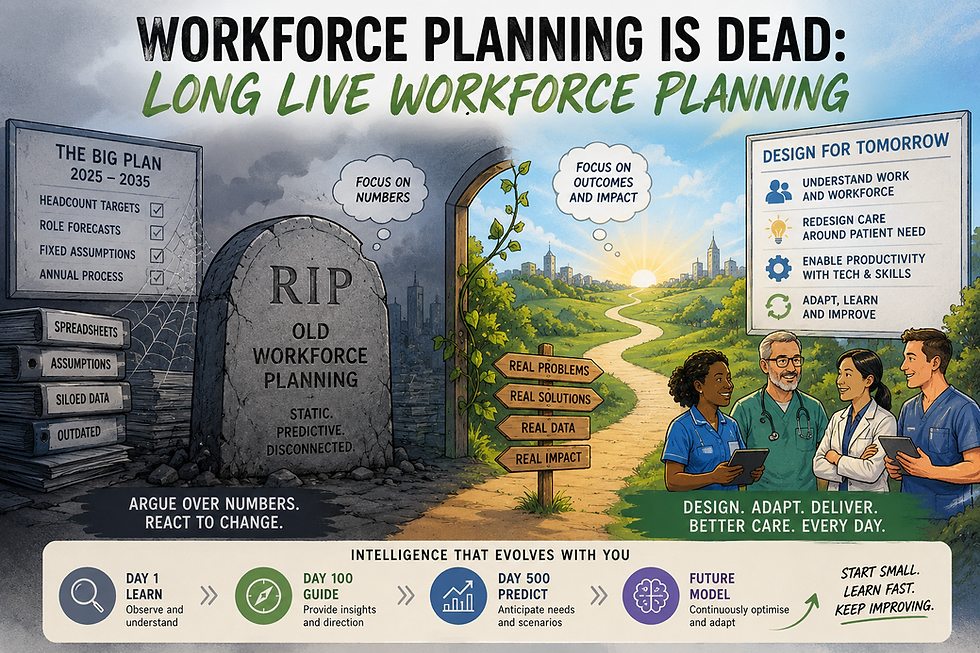
The NHS has spent decades trying to plan its workforce from above, with numbers set in stone and success measured in headcount. The incoming ten-year workforce strategy offers a chance to do something genuinely different. The question is whether we have the courage to take it.
There is a particular kind of optimism that attaches itself to large workforce plans. Governments and health systems produce them with great ceremony, fill them with ambitious projections, and then watch as reality quietly declines to cooperate. The NHS Long Term Workforce Plan, published in June 2023, was no exception. 1 It identified a projected shortfall of between 260,000 and 360,000 staff by 2036/37 and set out a detailed programme to train, retain and reform the workforce accordingly. The relief was real. After years of false starts, a plan had actually been published. And yet, less than two years later, the government's own ten-year health strategy had already described the growth assumptions underpinning it as "a fiction." 2
This is not, principally, a failure of intent. It is a failure of method. The logic of planning a fixed headcount for a system as complex and fast-moving as the NHS was always questionable. When the Institute for Fiscal Studies examined the financing implications of the 2023 plan, it found that delivering the workforce ambitions implied would require NHS England resource funding to grow at around 3.6 per cent per year in real terms, adding the equivalent of around £52 billion in today's money by 2036/37. 3 Numbers of that magnitude are not planning parameters. They are political battlegrounds. And so, predictably, the debate that followed was not about redesigning the NHS workforce for the three shifts from hospital to community, analogue to digital, and sickness to prevention. It was about who would fund the numbers and whether they were credible. The plan became a proxy for a funding argument that it was never equipped to resolve.
36%Increase in NHS full-time equivalent workforce since 2010, yet productivity remains 7–8% below pre-pandemic levels as of 2024/25, with growth in administrative and support roles particularly pronounced. NHS Employers, 2026 / DHSC Pay Review Evidence, 2026
The ten-year workforce strategy now in preparation offers a chance to break this pattern. But breaking it requires accepting an uncomfortable truth: trying to model, with precision, the exact workforce the NHS will need in a decade's time, built around a service model we are still designing, is not sophisticated planning. It is an exercise in false certainty. The three shifts are not a destination at which the NHS will one day arrive. They are a direction of travel, and the terrain between here and there is unmapped. Every version of a static headcount plan will be wrong before the ink is dry, not because the planners were careless, but because the system is too dynamic, and the world too unpredictable, for it to be otherwise.
The problem with planning from on high
There is a seductive logic to top-down workforce modelling. Feed in demand projections, assumptions about service redesign, training lead times and attrition rates, and out comes a number. Commission that number. Fund that number. Hit that number. The model feels rigorous because it is quantified. The trouble is that the NHS is not a spreadsheet, and its workforce is not a production schedule. The variables that actually shape whether a trust can recruit a community nurse or retain an experienced radiographer on any given Tuesday have very little to do with the national aggregate projected five years out. They have everything to do with the pay offer, the rota, the car park, the culture of the ward, and whether the community equipment store has what is needed to discharge the patient in bed seven.
Lord Darzi, in his independent investigation of the NHS in England, made the point with characteristic directness. Falling productivity, he observed, does not reduce the workload for staff. It crushes their enjoyment of work. Clinicians' efforts, he noted, are wasted on solving process problems rather than achieving better outcomes. The remedy is not to ask staff to work harder. It is to change the way they are deployed, making it easier for them to do their jobs. 4 That is a workforce planning insight, but it does not appear anywhere in a national headcount model. It appears in the daily reality of the ward, the community team, the outpatient clinic.
We cannot simply recruit our way out of this. The workforce of the future must deliver more value, with greater efficiency, while maintaining the compassion and quality that defines the NHS. Dean Royles, Interim Chief Executive, NHS Employers · June 2026
Dean Royles, writing as interim chief executive of NHS Employers in advance of the ten-year plan's publication, captures exactly this tension. 5 Since 2010, the NHS full-time equivalent workforce has grown by more than 36 per cent. It probably does not feel like that to the staff working within it, Royles observes, because the expansion has not always translated into proportional productivity gains. The growth in administrative, infrastructure and support roles has been particularly significant, with some non-clinical areas seeing increases of 40 per cent or more. We have got bigger. We have not necessarily got smarter. And the response to that observation should not be another headcount model. It should be a question: what are all those people actually doing, and is it the right thing?
Start on the ground, not from above
The low-hanging fruit in NHS workforce productivity is not difficult to identify, even if it has proven difficult to harvest. It is the administrative burden that holds clinical staff back from practising at the top of their licence. It is the referral forms that duplicate information already in the system. It is the rota systems that do not talk to each other, the paper processes that persist alongside digital ones, and the hours spent by senior clinicians doing work that could be done differently or not at all. A 2023 survey from the Institute for Public Policy Research estimated that NHS administrative costs in England have grown disproportionately to clinical output, and that clinical staff spend significant proportions of their working time on tasks that do not require their qualifications. 6
Royles sets out a practical framework for thinking about this that cuts through the usual abstraction. He argues that NHS chief people officers should build headcount measures that go beyond FTEs and vacancy rates to include capability and output metrics: skills utilisation, digital fluency, multidisciplinary team effectiveness, and outcomes per staff hour. 5 That is not a radical proposition. It is, in fact, the minimum that any sensible employer would want to know. And yet it remains genuinely unusual in NHS workforce planning, which has long been more comfortable counting people than understanding what they do. The NHS App alone is estimated to have freed up two million hours of staff time and 890,000 hours of GP time in 2023/24. 7 That is workforce planning. It just does not look like it because nobody modelled it in a ten-year projection.
The right question to ask at a service level is not "how many nurses will we need in 2035?" It is a cluster of more tractable, more actionable questions. What proportion of this clinical team's time is spent on direct care, and what proportion on tasks that could be automated, delegated or eliminated? Would investing in better administrative support free enough clinical time to improve throughput without any additional clinical hires? Could training in a specific skill set shift the case mix that a team can handle, reducing referrals upstream? What does a redesigned care pathway look like when you build it around patient need rather than around the organisational structures we inherited? These questions have answers that are discoverable, testable and improvable. The national headcount model does not.
The pandemic taught us something we are trying to forget
There is a lesson from the COVID-19 pandemic that the NHS workforce planning community has been somewhat reluctant to sit with. In March 2020, the rulebook was discarded. Clinical staff redeployed across settings in ways that would have taken years to negotiate in normal times. New roles were created in days. Elective pathways were suspended and rebuilt. Retired clinicians returned to practice within weeks. The bureaucratic friction that normally characterises change in a large public system largely vanished, because the alternative was unacceptable. And while the pressures were extreme and the human cost enormous, the operational flexibility revealed something important: the NHS is far more adaptive than its peacetime planning processes suggest. 8
That adaptability is not a crisis-only capability. It is a design choice. Systems that are built to be rigid, that plan in fixed cycles, that define roles tightly and change them slowly, will always be slower to respond to new realities than those that build in flexibility as a first principle. The Health Foundation has argued persuasively that agility is the missing ingredient for NHS productivity: the capacity to sense change, respond quickly, and learn continuously, rather than executing a plan written when the assumptions were different. 9 A ten-year workforce plan that enshrines a set of numbers and dares the system to hit them is the antithesis of that. A planning framework that sets a direction, identifies the principles for decision-making, and then trusts local systems to adapt within them is something else entirely.
£249m Estimated benefits from the NHS App in 2023/24 alone, freeing 2 million hours of staff time — a workforce gain achieved without a single additional hire, demonstrating the productivity potential of removing friction from existing roles. NHS England Productivity Report, December 2024
The agentic opportunity: start somewhere real
None of this is to say that workforce planning cannot become more sophisticated. The potential is, if anything, greater than it has ever been. The question is what sophistication actually means in this context. The vision that tends to attract the most enthusiasm from consultants and strategists is a maximalist one: a comprehensive agentic model that ingests every relevant data stream, integrates across finance, operations and HR, and produces real-time forecasts of workforce need that adjust autonomously as conditions change. Deloitte's work on autonomous workforce planning captures this direction of travel clearly, arguing that agentic AI should transform the workforce planning function from a static headcount exercise into dynamic, continuous talent orchestration. 10 The aspiration is compelling. The risk is that the perfect becomes the enemy of the good.
Deloitte's own research is instructive here. Despite the momentum behind agentic AI, only 14 per cent of organisations currently have deployable solutions, and just 11 per cent are actively running them in production. 11 Gartner projects that 15 per cent of day-to-day work decisions will be made autonomously through agentic AI by 2028. 12 These are not numbers that suggest an NHS trust should wait for a comprehensive integrated system before improving its workforce planning. They are numbers that suggest the field is maturing, quickly and unevenly, and that the organisations which will benefit most are those that start learning now rather than waiting for the technology to be fully formed.
The model worth considering is not "build everything, then deploy." It is "deploy something real, then build." Attach an analytical agent on day one and give it a specific, tractable problem to work on: rostering efficiency in a particular department, sickness absence patterns in a community team, the ratio of direct care time to administrative time across a clinical group. Let it learn. Over weeks and months, as it accumulates data and context, ask it to do more: to flag anomalies, to suggest interventions, to compare performance across comparable settings. Over time, as confidence in its outputs grows, ask it to begin modelling forward scenarios. This is not a diminished version of the agentic workforce planning vision. It is the version most likely to actually work, because it is grounded in the problems that the system already knows it has, and tested against reality at every step rather than at the end of a five-year implementation programme.
Deloitte's framing of agentic AI as analogous to a junior employee who learns by experience while performing valuable work 13 is a useful one for the NHS context. You do not ask a newly qualified analyst to model the entire workforce for the next decade on their first week. You give them a clear problem, good data and a supportive environment in which to develop. You measure what they produce. You correct errors. You gradually extend their scope as trust is established. The same logic applies to an agentic workforce planning system. It will not know everything on day one. Neither does any human planner. What matters is that it starts learning immediately, from real data, on real problems, and that the learning is cumulative rather than episodic.
The plan that should not be a plan
What, then, should the ten-year workforce strategy actually say? It should say that the NHS needs to get much better at understanding how its existing workforce spends its time, and at removing the friction that stops clinical staff practising at the top of their licence. It should commit to measuring productivity in terms of outcomes and outputs, not just inputs and headcount. It should set a direction for service redesign around the three shifts without pretending that this can be translated, today, into precise staffing numbers for a service model that does not yet exist. It should acknowledge that the right response to uncertainty is not a more detailed plan. It is a more capable system: one that can sense, respond and adapt continuously, at every level from the national to the ward.
And it should, finally, make peace with the idea that the numbers will change. The King's Fund has noted that NHS productivity is one of the most frequently reviewed and least frequently resolved challenges in modern health policy, with successive governments reaching for the same instruments, the same reviews and the same rhetorical commitments to cutting bureaucracy, without sustaining the operational changes needed to make them real. 14 What is different now is not the aspiration. It is the technology available to support continuous learning, and the clarity of the policy direction provided by the three shifts. Both of those create genuine opportunities. Neither of them requires a fixed headcount plan to realise.
The NHS workforce planning framework that will serve the system well over the next decade is one that starts on the ground, with real problems and real data; that adapts continuously rather than replanning in cycles; that uses emerging technology to build expertise progressively rather than waiting for a comprehensive solution that may never arrive; and that resists the political temptation to reduce a complex, dynamic challenge to a number that can be announced, argued over and then quietly abandoned. Workforce planning in that mode is not dead. The version that treats it as a technical exercise in modelling a fixed future is. The sooner we accept that distinction, the sooner the real work can begin.
References
NHS England (2023) NHS Long Term Workforce Plan. London: NHS England. Published 30 June 2023. Available at: www.england.nhs.uk
Nuffield Trust (2025) Plan B: What the forthcoming NHS workforce strategy should not ignore. London: Nuffield Trust. Available at: www.nuffieldtrust.org.uk
Institute for Fiscal Studies (2023) Implications of the NHS workforce plan. London: IFS. Available at: ifs.org.uk
Department of Health and Social Care (2025) 10 Year Workforce Plan: call for evidence document. London: DHSC. Available at: www.gov.uk [citing Lord Darzi's independent investigation]
Royles, D. (2026) 'Beyond recruitment: Five priorities for CPOs facing the NHS productivity challenge.' NHS Employers. 1 June 2026. Available at: www.nhsemployers.org
Institute for Public Policy Research (2024) From the frontline. London: IPPR. November 2024.
NHS England (2024) NHS Productivity. London: NHS England. Published December 2024. Available at: www.england.nhs.uk
NHS England (2020) NHS response to COVID-19: workforce redeployment and emergency measures. London: NHS England.
The Health Foundation (2021) Agility: the missing ingredient for NHS productivity. London: The Health Foundation. October 2021.
Cantrell, S., Moss, K., Klosk, R., Domergue, C., Tomke, C. and Shaw, Z. (2025) 'Autonomous workforce planning: Agentic AI isn't just joining the workforce — it's reshaping how organisations plan for it.' Deloitte Insights. Available at: www.deloitte.com
Deloitte (2025) 2025 Emerging Technology Trends. Deloitte Insights.
Gartner (2024) Leadership Vision for 2025: Chief HR Officer. Cited in Deloitte Insights, 2025.
Deloitte (2024) Autonomous generative AI agents. Deloitte Insights / TMT Predictions. December 2024. Available at: www.deloitte.com
The King's Fund (2024) 'Thoughts on the NHS's productivity decline.' The King's Fund. February 2024. Available at: www.kingsfund.org.uk


Comments